There’s Turkey in the Oven
A Design That Smells Like Warm Kitchen Memories
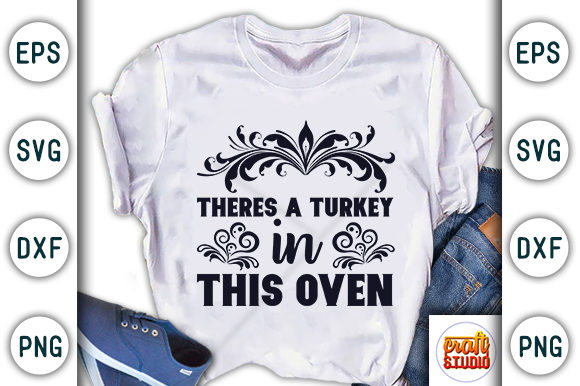
First glance at There’s Turkey in the Oven lands like a well-timed chuckle—friendly, slightly cheeky, and instantly recognizable. It’s not fussy or overly detailed; it leans into bold, rounded shapes with clear negative space and a warm, inviting rhythm. The turkey sits front-and-center, plump and stylized—not photorealistic, but expressive enough to read as “holiday,” “home,” and “handmade” all at once. As an embroidery designer who’s stitched hundreds of seasonal graphics, I immediately saw its sweet spot: cozy, approachable, and built for legibility at 3–4 inches wide. It feels less like clip art and more like a hand-drawn kitchen note pinned to a corkboard—exactly the tone that sells on tote bags, tea towels, and baby onesies.
Where It Shines (and Where It Needs a Little Help)
I tested There’s Turkey in the Oven as the focal point on a heavyweight cotton canvas tote—stitched at 3.75 inches wide with matte poly thread. The result? Clean satin-stitched turkey body, crisp running-stitch oven outline, and readable lettering without crowding. Customers loved the warmth and humor—it reads as personal, not mass-produced. That same design translated beautifully onto a brushed cotton sweatshirt (medium-weight, stable knit), where the open layout kept stitch density manageable and avoided puckering. On baby onesies? A scaled-down version (2.5") held up well with lightweight cutaway stabilizer—soft enough for sensitive skin, distinctive enough for gifting.
But here’s where real-world judgment kicks in: There’s Turkey in the Oven isn’t magic on every surface. On thin jersey tees, the lettering tightens up and risks bleeding without precise tension control. On dark fabric, especially navy or charcoal, the white or light fill areas need high-contrast thread—or a subtle underlay—to avoid looking washed out. And while the oven door handle and turkey’s wing details are charming in vector form, they shrink into ambiguity below 2 inches. If you’re planning caps or curved hat fronts, test that corner detail first—it’s where small-scale embroidery often blurs.
Design Integrity Meets Real Customer Expectations
What makes There’s Turkey in the Oven work commercially isn’t just charm—it’s clarity. In my Etsy shop, holiday-themed embroidered patches sell best when they balance whimsy with craftsmanship. This design delivers that: no tiny serifs, no overlapping layers, no fragile stems or hair-thin lines. That means fewer reworks, faster turnaround, and higher perceived value in finished products. When customers see it on a linen pillow cover or an apron, they don’t think “clip art”—they think “someone made this *for* me.” That trust is gold for craft businesses, especially during November and December.
It also holds up across branding contexts. I used it as part of a small-batch boutique’s holiday line—paired with simple “Gather & Give” and “Gravy Is My Love Language” designs—and it anchored the collection visually without competing. Its friendly scale and balanced weight make it equally at home on a printable mockup for social media or stitched directly onto a kitchen towel sold at a local craft fair.
Practical Notes Every Embroiderer Should Check Before Stitching
- Test on scrap fabric first—especially if using textured weaves, terry cloth, or stretchy knits. The oven’s straight edges respond differently than the turkey’s curves.
- Review stitch density before scaling down. At under 2.25", the turkey’s breast fill may look sparse without a slight density bump.
- Confirm hoop size compatibility. The full layout fits comfortably in a 4" x 4" hoop—but check your machine’s actual usable area, not just the frame size.
- Inspect small details in black-and-white mockups. Some screens wash out fine lines; what looks sharp on screen may vanish mid-stitch.
- Use appropriate stabilizer. Light cutaway for stable wovens, tear-away for towels, and fusible + cutaway combo for baby items.
- Verify licensing terms before selling finished embroidered items or bundling the digital files. Since There’s Turkey in the Oven includes EPS, SVG, PNG, and DXF formats, confirm whether commercial use applies to both physical products and digital resale.
Not Just a T-Shirt Design—A Thoughtful Graphic Asset
Calling There’s Turkey in the Oven a “T-Shirt Design” undersells it. Yes, it works on tees—but its real strength is versatility across handmade product categories. As a Graphics file set, it bridges digital prep and physical execution: SVG for cutting machines, PNG for print-on-demand mockups, EPS for vector refinement, DXF for CNC or vinyl workflows. That flexibility matters to Etsy sellers juggling embroidery, heat transfer, and sublimation—all from one cohesive holiday theme.
I’ve used it in three distinct ways recently: as a central motif on a custom-embroidered apron for a local chef’s pop-up (scaled to 4.25", with gold metallic thread accents); as a repeat pattern border on a set of linen napkins (using only the oven outline in monochrome); and as a playful appliqué base for a baby quilt kit (cut from flannel, then outlined in matching thread). Each time, the design retained its voice—never generic, never strained.
Final Thought: It’s Not About Perfect—It’s About Right
There’s Turkey in the Oven won’t win awards for technical complexity. But it wins where it counts: in how it feels when stitched, how it reads from across a room, and how warmly it’s received as a personalized gift or small-shop product. For embroidery designers and creative entrepreneurs, that kind of reliable, human-centered performance is rare—and worth holding onto. Use it thoughtfully, test it honestly, and let its warmth do the rest.